
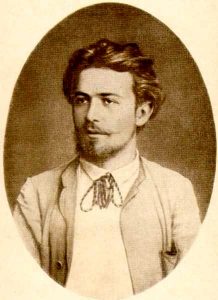
Don’t tell me the moon is shining; show me the glint of light on broken glass.
—Allegedly by Chekhov (but not really)
Chekhov never said this. He especially didn’t say “don’t tell me the moon is shining.” That wouldn’t have made sense to him.
This misunderstanding comes from a letter he wrote to his brother Alexander in May 10, 1886, which is known mostly from an ambiguous excerpt:
For instance, you will succeed in depicting a moonlit night if you write that on the mill dam a piece of glass from a broken bottle flashed like a bright star and the black shadow of a dog or wolf rolled along like a ball and so forth. Nature comes alive if you’re
not squeamish about comparing natural phenomena to human actions.—Translation by Cathy Popkin, in her edition of Anton Chekhov’s Collected Stories (New York: W. W. Norton, 2014), p. 517.
Where’s the “don’t tell me the moon is shining” part? Nowhere. He never said it. Why not? Because he didn’t write that way. He would have found the concept absurd. We can tell because he took his “moonlight” example from one of his stories, Hydrophobia, which was published a couple of months before his letter to Alexander. Here’s how he embodied his own advice (emphasis mine):
The dam, flooded with moonlight, showed not a bit of shade; on it, in the middle, the neck of a broken bottle glittered like a star. The two wheels of the mill, half-hidden in the shadow of an ample willow, looked angry, despondent…
—Translated by Avrahm Yarmolinsky, The Unknown Chekhov Stories and Other Writings (New York: Funk & Wagnalls, 1954), p. 98.
Note that Chekhov says “moonlight” fair and square. The idea that he had anything against saying the moon is shining is simply not true!
So What Was Chekhov Really Talking About?
The usual excerpt doesn’t even give the entire paragraph, let alone the whole letter. Here’s the entire paragraph, (a machine translation of the original Russian):
In my opinion, descriptions of nature should be very brief and have the character of à propos. Commonplaces like “The setting sun, bathing in the waves of the darkening sea, poured crimson gold,” etc., or “Swallows, flying over the surface of the water, chirped merrily”—such commonplaces must be thrown out. In descriptions of nature one must seize upon small particulars, grouping them so that when you close your eyes after reading, a picture emerges. For example, you will get a moonlit night if you write that on the mill-dam a bright star-like glint flashed from a piece of broken bottle and a black shadow rolled like a ball—the shadow of a dog or a wolf, etc. Nature comes alive if you do not disdain to compare its phenomena to human actions, and so on.
The Value of Small Particulars
The point in using small details is not to avoid big ones but to make the scene pop. Chekhov is a master of the psychology of art, and he knows that if you paint a scene with broad brush strokes, adding a tiny detail will make it pop. The unconscious mind, seeing one or two tiny details, will assume that there must be plenty more where that came from. With this cue, we gain the illusion of great detail, though we won’t know what most of the details are.
Notice the dissonance: a moonlit millpond is conventionally a romantic prospect. A broken bottle is trash and doesn’t belong in a romantic scene. This dissonance is a second way of popping the scene into three dimensions: it’s no longer cliché. Anything unexpected has this effect.
Notice, too, that a glint is about as tiny as a detail can possibly be. I think that a detail that’s tiny (but not so tiny that noticing it is implausible) adds to the effect in a way that mentioning a dead tree or other larger object would not.
The Curse of the Commonplace
On the other hand, commonplace expressions “must be thrown out” because the hackneyed, the cliché, the expected don’t bring much to the party. Well, except clarity, which is nothing to be sneezed at, but let’s not fool ourselves into thinking that our readers will be deeply moved by moons in June and soft caressing breezes. They’ve heard it a million times. As a means of setting the stage, fine, that sort of thing is fine if we deal with it briskly and move on to something that’s at least a little bit unexpected and hopefully relevant to what happens next.
Chekhov’s Advice to His Brother
At the time, Chekhov’s brother Alexander was working on a story, The City of the Future. Most of the letter is advice about how to go about writing the story. It’s an interesting set of advice (if your goal is to understand it and not take it as gospel), and it’s too bad that it hasn’t been more widely disseminated. Here is the full set of advice in his letter. (This is a machine translation of the original Russian: it doesn’t seem to have been published in English):
“The City of the Future” is a magnificent theme, both for its novelty and its interest. I think that if you do not get lazy, you will write it quite well, but damn it, what a sluggard you are! “The City of the Future” will turn out to be a work of art only under the following conditions: 1) absence of long-winded outpourings of a politico-socio-economic nature; 2) complete objectivity; 3) truthfulness in the description of persons and objects; 4) extreme brevity; 5) courage and originality; flee from clichés; 6) heartfelt warmth.
In my opinion, descriptions of nature should be very brief and have the character of fitting naturally into the narrative. Commonplaces like “The setting sun, bathing in the waves of the darkening sea, poured crimson gold,” etc., or “Swallows, flying over the surface of the water, chirped merrily”—such commonplaces must be thrown out. In descriptions of nature one must seize upon small particulars, grouping them so that when you close your eyes after reading, a picture emerges. For example, you will get a moonlit night if you write that on the mill-dam a bright star-like glint flashed from a piece of broken bottle and a black shadow rolled like a ball—the shadow of a dog or a wolf, etc. Nature comes alive if you do not disdain to compare its phenomena to human actions, and so on.
In the sphere of psychology too—particulars. God save us from commonplaces. It is best to avoid describing the mental state of the heroes; one should try to make it clear from their actions… There is no need to chase after a multitude of characters. The center of gravity should be two: he and she…
My Commentary
Chekhov’s numbered list pretty much speaks for itself. I find myself stumbling over “2) complete objectivity” because I’m not a fan of cold, robotic narration, but that’s not what he means, because of “6) heartfelt warmth.” I suppose he means in point #2 to not lie to yourself or the readers about the events and persons themselves, but to tell it like it is, but not icily.
“4) extreme brevity” is no doubt meant by Victorian standards; Chekhov’s sentences and paragraphs aren’t especially brief by our standards.
He complains about “commonplaces” (cliched, hackneyed, tired phrases) in all three paragraphs, so I suppose he means it. My personal view is a little different: I don’t expect commonplaces to pack a punch like a freight train, but it’s not as if I’m trying to knock you into a three-day coma with every single sentence. But when I am, I agree with Chekhov: I need custom-tailored prose, not something off the rack.
As for not describing the hero’s mental state: Chekhov does this all the time! Well, okay, he does this whenever the situation and the action haven’t done it for him, which is probably his point. Sometimes events practically force the hero into a specific mental and emotional state, and which one will be obvious to the reader. Other times, it’s not so clear, but simply confirming which way their mind jumped is enough; that is, giving their inner reaction in detail doesn’t add anything worth having. With still others, the character’s inner reaction is a closed book to the reader unless we go inside and wave our narrative flashlight around. But spelunking inside the character’s skull shouldn’t be the default. I think that’s what Chekhov meant.
All in all 10/10. Would recommend.
Relevance to “Show, Don’t Tell”
What does any of this have to do with “show, don’t tell”? Very little. Chekhov’s name only got dragged into the argument because people misinterpreted a published fragment of one paragraph in his letter to Alexander, without comparing the advice to the story it draws upon.
Origin of Show, Don’t Tell
As a slogan, “Show, don’t tell” is originally from theater. The idea is that a good sequence should likely be shown (enacted on stage) instead of just having one character tall another about it. Otherwise you shortchange the audience. (The flip side is that a dull sequence should likely be dispensed with in a couple of spoken lines.)
Its applicability to prose fiction is less direct. The idea that we should show the good stuff in full (that is, enact or dramatize it) instead of summarizing it has been around since at least the nineteenth century. This has nothing to do with refusing to use words like “angry,” though, and doesn’t imply that we shouldn’t mix and match as Chekhov does in his “moonlight” example.
Language vs. Body Language
Humans are exceptionally good at body language. We know the difference between a sincere and an insincere smile at a glance, though we generally can’t explain how we know. It’s typical for us to know someone’s state at a glance without knowing why.
This leaves us without purely physical descriptions of mental states like “he sat in his chair looking like he’d lost his last friend” or “he was furious.” I defy anyone to write a purely physical description of someone simply sitting in a chair looking like they’d lost their last friend without implying illness as least as strongly as loss. It can’t be done.
But the “show, don’t tell” zealots insist that it must be done. They’re wrong, and their attempts at doing so work just as poorly as you’d expect. Don’t be like them. Use purely physical description only for things that can be described (with adequate clarity and pizzazz) in purely physical terms. (Duh!) For everything else, add something else to the mix, like labels and figurative language. Don’t let Writing 101 rules force you into vague and stilted language.
My Advice
My advice about “show, don’t tell” is to pretend you never heard it. It’s a lame and confusing attempt to explain that you should depict action when the action is interesting enough to depict, use omission or summary to get past the stuff that isn’t, and to label things as needed for clarity.
Lots of Writing 101 advice tells you to avoid different aspects of the language. This is wrong. It’s a band-aid to help you avoid common beginner’s mistakes for a few weeks until you’re writing more deliberately. The problem is that you don’t get any follow-up advice.
My advice: rip off the band-aid! Embrace the entire language as your rightful playground. The passive voice and adverbs are there to be used joyfully. Saying the moon is shining is a great way of letting your reader know that the moon is shining. Just don’t stop there.